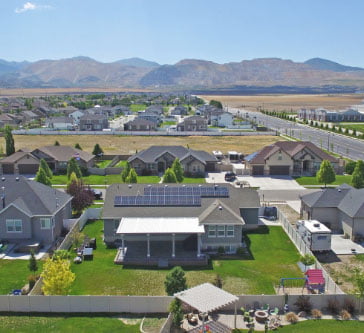
It's important to stay up to date of how changes to possible solar tax credits may impact your ability to obtain solar power for your home or business, and one major change has recently taken place. Via president Donald Trump's One Big Beautiful Bill being signed into law in July 2025, the 30% federal solar tax credit that has been offered to residents around the nation will be ending on December 31, 2025.
At Intermountain Wind & Solar, we're here to offer the very best residential solar power services and help with all related financial areas to clients around Utah and Idaho, including residential solar incentives like the federal tax credit. So, what is happening to the solar tax credit in 2025, and what does the 30% federal solar tax credit ending mean for potential solar customers around Utah? Here's a deep dive into this important and timely topic.
As we noted above, the signing of the One Big Beautiful Bill in summer of 2025 includes a provision that the 30% federal solar tax credit is ending at the end of this calendar year, on December 31st. But what does this actually mean, and how will it affect your cost and savings on solar for your home?
First, let's take a closer look at the federal solar tax credit itself. This incentive was first implemented in 2006 as part of the Energy Policy Act and has been extended multiple times since then. The credit allowed homeowners to deduct various percentages of their solar system costs from their federal income taxes.
The incentive has been a major part of the rise of solar power in the United States, making it more affordable for homeowners to invest in renewable energy. It has allowed numerous families to not only save money on their energy bills, but also make a positive impact on the environment.
In recent years, there have been discussions and proposals for changes to the federal solar tax credit. Some argue that it should be extended indefinitely to continue promoting the use of renewable energy sources. Others believe it should be phased out gradually as the cost of solar technology decreases and becomes more accessible without government incentives.
The current percentage is 30%, which was initially scheduled to decrease somewhat before ending in the mid-2030s. However, president Trump's bill sped up this process, and the credit will expire entirely at the end of 2025. What will this mean for Utah homeowners, businesses and the local economy? Our next few sections will dive in.
For homeowners who may be considering installing solar panels on their property, the end of the 30% federal tax credit may change their decision-making process. With less financial incentive from the government, homeowners may be more hesitant to invest in a solar energy system after December 31, 2025.
In other cases, however, this may lead to a bit more urgency. Homeowners who are able to install their system before the end of 2025 will still qualify for the full 30% credit, and there is no retroactive component. This means that those who have already installed solar panels will not see a decrease in their tax credit. To be clear, homeowners must have their solar (or battery) systems fully installed and operational by the end of 2025 to claim the 30% credit. Simply paying for it or signing a contract isn’t sufficient.
So if you've been on the fence about going solar, now is the time to act. With the current federal tax credit still in place and the end of the home solar tax credit on the horizon, there is no better time to invest in renewable energy for your home.
Homeowners who act before the end of 2025 can still take advantage of the 30% federal solar tax credit, which allows them to deduct nearly a third of the cost of a purchased solar system from their federal taxes. For example, on a $25,000 system, this credit could save a homeowner $7,500, a substantial reduction in upfront costs that shortens the payback period and improves the overall return on investment. In many cases, claiming the credit can cut one to three years off the time it takes for the system to pay for itself, depending on energy costs and system size. With the credit set to expire after 2025, locking in a solar installation now is the only way to secure these savings and maximize the financial benefits of going solar.
Because the tax credit being removed is residential in nature, businesses will not face the same consequences as homeowners. However, this does not mean that businesses are completely unaffected by the end of the federal solar tax credit. The 30% federal Investment Tax Credit (ITC) for commercial solar projects, governed under Section 48E, remains available, but businesses now face much faster timelines under the new “One Big Beautiful Bill”. To qualify for the credit, companies must begin construction on their solar project by July 4, 2026, or ensure the system is fully operational (placed in service) by December 31, 2027.
At Intermountain Wind & Solar, we're proud to offer free consultations and quotes on solar systems, plus information on how these changes may impact your project. Contact us to begin working with a trusted Utah-based provider who is ready to help you take advantage of solar incentives before they disappear!
Solar panels and related technology have improved in several major ways over the last several years and decades, and one top example here is the rise of solar home battery storage. What is home battery backup storage, and why has it become more and more popular among owners of homes or buildings with solar panel setups?
At Intermountain Wind & Solar, we're proud to offer a wide range of solar energy services to clients around Salt Lake City, Utah and Boise, Idaho areas, including home battery installations featuring top battery products like the Enphase battery and others. Here are some basics on why solar home batteries have skyrocketed in popularity recently, plus some of the chief roles they play and benefits they carry as a complement to any solar panel system.
To truly understand why home battery backup products for solar power have become so popular and useful, you have to look back at the evolution of solar panels themselves. Early iterations of these products were somewhat limited in their energy conversion and production capabilities - often only enough to create limited or temporary power.
As they evolved, however, the technology behind solar panels improved exponentially, leading to increased energy production and efficiency. And as a result, owners of solar panel setups increasingly found themselves producing more energy than they actually needed.
To address this, new technologies were developed that allowed for excess energy to be stored and used when solar panels weren't able to generate power - such as overnight or on cloudy days. One such technology is the solar battery, which stores excess solar energy in a chemical form for later use. These batteries are becoming increasingly popular among homeowners with solar panel setups, as they provide a reliable source of backup power during times when the sun isn't shining.
Very quickly once they were introduced to the market early in the days of solar panel adoption decades ago, solar batteries gained immediate popularity. While they were not always the most affordable in those early years, they provided great value for residential or commercial solar energy setups.
And in recent years, as the technology has become even more affordable and efficient, the use of solar batteries has only continued to grow in popularity. This is due to several key factors:
One major factor driving the popularity of solar batteries is their decreasing costs. With advancements in technology and increased production, the cost of solar batteries has significantly decreased over the years. This makes them a more accessible option for both residential and commercial consumers.
Another reason for the rising popularity of solar batteries is their ability to provide energy independence. By storing excess energy produced by solar panels during peak hours, individuals and businesses can rely less on traditional power grids and potentially save money on electricity bills. Additionally, during power outages or natural disasters, solar battery systems can serve as a backup power source, providing a sense of security and self-sufficiency.
Solar batteries are also considered an eco-friendly solution for energy storage. Unlike traditional power sources that rely on non-renewable resources such as fossil fuels, solar batteries utilize renewable energy from the sun. This helps reduce carbon emissions and lessen environmental impact, making them a popular choice among environmentally conscious individuals and businesses.
Because solar batteries have the ability to store excess energy and release it back into the grid when needed, they can help stabilize the power grid. This is especially beneficial during peak demand periods when there is a strain on the grid. By providing a backup source of energy, solar batteries can help prevent blackouts and brownouts.
If you've determined that a solar battery is the right choice for your home, there are a few factors to consider when choosing the right one. Some key considerations include:
At Intermountain Wind & Solar, we're happy to offer a wide range of solar home battery installation services around Utah and Idaho. Contact us today to learn more about how a home battery system can benefit your household.
Utah residents and businesses are facing a perfect storm of rising Utah power rates, and it’s more critical than ever to consider alternatives. Rocky Mountain Power (RMP) has recently implemented a nearly 20% increase in energy costs through its Energy Balance Adjustment (EBA), hitting many households hard. But that’s not the end of the story. RMP is now seeking a 30%+ base rate increase from the Utah Public Service Commission, and starting January 1, 2024, customers will also see an additional $3.47 per month charge on their bills. This fee, part of a new legislative mandate, will fund a self-insurance program to cover wildfire risks.
These changes are not hypothetical—they are happening right now, and they represent a significant burden for Utahns. The Energy Balance Adjustment, which alone has caused some bills to spike by 19.88%, is just the beginning. This adjustment allows RMP to pass the full cost of fuel and purchased power directly to customers—no buffer, no sharing the burden. Now, with the utility pushing for a base rate increase of over 30%, citing the need to cover rising operational and capital costs, energy prices are poised to soar even higher. If approved, this would be one of the most significant rate hikes in recent memory, pushing Utah power rates to new heights.
Certain events within the world of power rates and energy prices can have an enormous effect on the entire local sector, and energy clients around Utah have just seen a recent example. Just a few weeks ago, Rocky Mountain Power - the company that supplies electricity to around 80% of Utah - asked the state for a massive increase in power rates that has caused major unrest among many customers.
At Intermountain Wind & Solar, we're here to offer an alternative to the ever-increasing prices and unreliability of the electrical grid. We offer the best solar energy services in Utah, providing both residential and commercial solar power services to clients around the state and helping them work to full energy independence. Let's look at the specifics of this requested rate increase from Rocky Mountain Power, and the impact this is expected to have on customers - plus some basics on why switching to solar might be the right move for you to help avoid these issues.
As noted in the article linked above, RMP has requested a 30.6% increase in power rates over the next 18 months. This proposal is set to come in two phases, one in February 2025 and the next in January of 2026.
This first phase would see the power rates for residential clients climb from 10.96 cents per kilowatt-hour up to 12.89 cents, which would increase the average customer's monthly bill up by nearly $14. The second phase would see yet another increase to 14.31 cents, adding over another $10 to the average customer's bill. Even businesses and industrial clients will see increases, though they will be in smaller percentages than for residential clients.
Furthermore, this may not even be the end of things. This request doesn't include funding for a wildfire mitigation fund, which could include RMP collecting even further additional money from individual clients. It's no wonder many Utahns are frustrated at this news.
The primary reasoning RMP has used for this rate increase request is the price of fuel, along with the cost of new infrastructure. It's true that both coal and natural gas have seen price increases recently, and that these costs can be passed on to consumers.
However, there are significant questions as to whether these proposed rate hikes are necessary, or if they're simply a way for RMP to increase their profits. In the past, the company has been known to present inflated estimates of future costs in order to justify these increases - something that could very well be happening again here.
The reaction to this request has been largely negative, for understandable reasons. There has been both a public outcry and statements from state leaders like Governor Spencer Cox, who pledged in a social media post to do everything he could to ensure the increase - which he called "laughable" and "dangerous" - does not come to pass.
And to be clear, this request does not signal finality here. The Utah Public Service Commission must approve the increase before it can take effect, a process that is still yet to play out. It's clear, however, that customers are looking for alternatives to the traditional power grid - and with good reason.
If you're looking for a way to reduce your reliance on the grid and avoid these kinds of rate increases, switching to solar power is an excellent option. Solar energy can provide reliable and affordable electricity to both residential and commercial properties, helping you save money in the long run while also reducing your carbon footprint.
In addition, by using solar panels to generate your own electricity, you're no longer at the mercy of constantly increasing fuel costs or infrastructure upgrades. You'll have peace of mind knowing that your energy supply won't be affected by external factors.
Furthermore, there are many incentives available for those who switch to solar - including tax credits and rebates - making it even more financially appealing. Plus, with advancements in technology, solar panels are becoming increasingly efficient and cost-effective, making it a smart investment for the future.
The requested rate increase from Rocky Mountain Power is just one example of why relying solely on the traditional electrical grid can be problematic. Whether it's due to fuel price increases, infrastructure costs, or other factors, these kinds of rate hikes are becoming more common and will continue to affect customers in the years to come. By switching to solar power, you can take control of your energy supply and protect yourself from these types of issues while also contributing to a cleaner environment.
Contact Intermountain Wind & Solar today to learn more about how we can help you make the switch to solar energy and achieve greater energy independence. Together, we can create a brighter future for Utah and beyond.


"All of the photos on this website are of real projects that Intermountain Wind & Solar has designed and installed.
We are proud to show off and stand behind our work."