If you want to determine the solar potential of your property, Google’s online tool, Project Sunroof, can help.
When Google created Project Sunroof in 2015, its coverage area was limited. Since then, however, Google has greatly expanded, and now states in the Intermountain West are included in the database.

Google’s online tool makes finding the solar potential of your home quick and easy.
Plug in your address, and through the power of Google Maps, the tool calculates the amount of sunlight that hits your roof over the course of a year. The site uses high-resolution aerial imagery, so you can see a 3D model of your roof and envision the placement of a solar panel system.
Because Google uses an advanced computer algorithm that reduces errors, this tool is considered to be more accurate than many other solar calculators.
To determine your solar potential, the program factors in the sun’s position throughout the year and shading from nearby trees and buildings.
Then, Google’s online tool recommends a solar panel system size that is capable of powering your home. This figure is based on the average monthly electric bill in your area, but you can tweak the amount if your utility bills are higher or lower.
After offering a cost estimate, the program determines how much you could save by installing a solar energy system. General information about financing is also provided, so you can get a look at your potential annual savings.
Google’s tool is helpful for exploring solar potential, but it has its limits. As the program is automated, it cannot address any unique features of your property.
In addition, Project Sunroof is purely informational. The site is unable to answer questions regarding the results of the property evaluation.
An experienced professional photovoltaic contractor can provide you with more comprehensive information than the Google tool.
Not every rooftop is a good fit for a photovoltaic installation. Some are structurally unsound while others have shading issues. But many properties can accommodate a ground-mounted solar array — an option not considered by Project Sunroof.
The professional team at Intermountain Wind & Solar, the region’s leading photovoltaic provider, serves residential and commercial customers in Idaho, Utah and Wyoming. Contact us today to discuss your home’s solar potential and request system pricing information.
Project Sunroof’s tool estimates rooftop solar output with ±10% accuracy using 3D LIDAR and 10 years of local weather data. Intermountain Wind & Solar refines this with an on-site shading survey, delivering ROI projections within 5% of actual system performance.
Project Sunroof factors roof tilt, orientation, shading from trees or buildings, and historical irradiance from NASA satellite data. Intermountain Wind & Solar adds local utility rates in Utah, Idaho, Wyoming and Oregon to forecast precise cost-per-kWh savings over 25 years.
After you download your solar map, contact Intermountain Wind & Solar to review system size, estimated annual kWh, and 25-year savings. Our in-house engineers deliver a full proposal—including permits and timeline—typically within 2 weeks.
Project Sunroof focuses on panels, but IWS offers a complete ecosystem. Add a Tesla Powerwall 2 or Enphase battery for up to 6 kW backup and a 48-amp EV charger. Bundled installations can reduce overall equipment cost-per-watt by up to 12%.
Intermountain Wind & Solar offers cash purchases, leases and loans with 0% down in many markets. Bulk purchase discounts can cut equipment costs by 8%. Utah customers typically see payback in 6–8 years based on current utility rates.





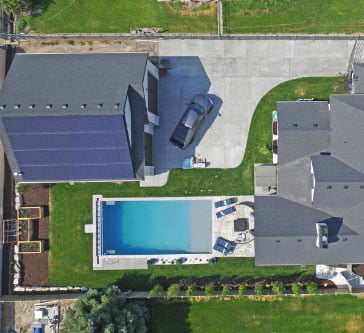
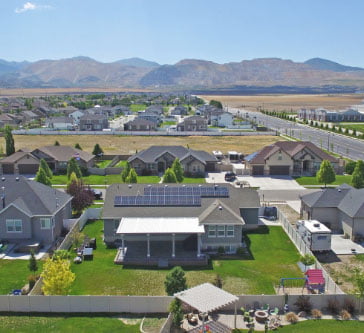
"All of the photos on this website are of real projects that Intermountain Wind & Solar has designed and installed.
We are proud to show off and stand behind our work."