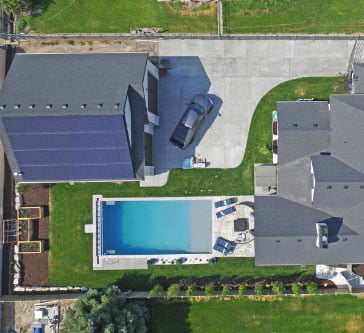

Charging an electric car with solar energy keeps your home running clean and reduces reliance on the utility grid. A dedicated home battery allows you to capture surplus solar power generated during peak daylight hours and use it to power your vehicle overnight. Pair your vehicle with a Tesla Powerwall installation from Intermountain Wind & Solar in Salt Lake City, Utah, or Boise, Idaho, to turn your residential property into a fully self-sustained clean energy hub.
Integrating battery storage into your home system eliminates the cost spikes associated with standard EV charging. Pairing solar panels with dynamic storage allows you to balance heavy appliances alongside electric car charging without overloading your panel or drawing expensive grid electricity. Contact Intermountain Wind & Solar today to discover how our local experts across Utah and Idaho can transform your energy setup.
Standard solar arrays generate maximum electricity during midday hours when many electric vehicles sit parked away at workplaces. Without a storage system, that excess energy gets pushed back to the local utility grid. Installing a home battery allows you to store every surplus kilowatt-hour produced by your rooftop panels during the afternoon.
When you plug in your electric car at night, your charger draws power directly from the stored solar energy rather than relying on grid power. This direct consumption maximizes energy efficiency and protects you from rising utility rates. Stored solar energy provides a clean fuel source that keeps your transportation costs low and consistent.
Utility providers across Salt Lake City and Boise often enforce time-of-use (TOU) rate structures. During peak evening hours, grid electricity costs can spike significantly. Charging an electric car directly from the grid during these high-demand periods leads to expensive monthly energy bills.
Smart battery management allows you to set automated schedules for your energy usage. You can program your system to charge your electric vehicle during off-peak hours using stored solar power, effectively bypassing peak utility prices.
| Charging Strategy | Power Source | Grid Rate Impact | Outage Resilience |
| Standard Grid Charging | Utility Grid | High (Peak Rates) | No |
| Direct Daytime Solar | Solar Panels Only | Very Low | Partial |
| Stored Powerwall Charging | Battery + Solar | Lowest (Zero Peak Use) | Full Backup |
Electric cars draw significant power while charging, which can strain a home electrical system when paired with central air conditioning, heating, or kitchen appliances. Smart power management coordinates these competing demands so your primary home circuits operate smoothly.
Through intelligent load monitoring, your home battery automatically adjusts output based on real-time household energy draw. During periods of heavy energy use, the system prioritizes key household appliances while regulating vehicle charging speeds. Once household demand drops, maximum power redirects to your electric car, ensuring a full charge without overtaxing your electrical panel or drawing grid electricity.
Combining solar generation, battery storage, and electric car charging into a unified framework turns isolated components into a single home energy setup. Centralized mobile app controls give you complete visibility over energy production, storage capacity, and consumption metrics in real time.
During power outages, this integrated architecture keeps critical circuits running. While grid-tied solar panels without storage shut down for safety during a blackout, a integrated solar-plus-battery setup disconnects from the grid and continues producing power. This setup allows your solar panels to replenish the battery during the day so you can maintain both home backup power and essential vehicle charging.
Yes, a home battery system can supply power to your EV charger during a grid outage. However, because charging an electric vehicle uses significant energy, it is best to manage your charging speed to preserve backup power for essential home appliances.
A single battery provides 13.5 kWh of usable capacity, which adds roughly 30 to 40 miles of daily driving range to most electric vehicles. If you have a longer commute or multiple electric cars, installing a second unit increases your available storage.
Charging your car with solar energy costs significantly less per mile than using standard utility grid power or gasoline. Storing midday solar electricity to charge your vehicle overnight eliminates peak-rate utility charges entirely.
Upgrading your home energy setup with Tesla Powerwall EV charging delivers maximum self-reliance, lower monthly power bills, and seamless protection against grid outages. By pairing rooftop solar panels with advanced battery storage and smart vehicle charging, homeowners across Salt Lake City, Utah, and Boise, Idaho, can take control of their power consumption.
The experienced team at Intermountain Wind & Solar handles every step of the installation process, from initial design and permitting to complete system activation. Contact Intermountain Wind & Solar today to schedule your consultation and build an efficient, future-proof home energy solution.





"All of the photos on this website are of real projects that Intermountain Wind & Solar has designed and installed.
We are proud to show off and stand behind our work."